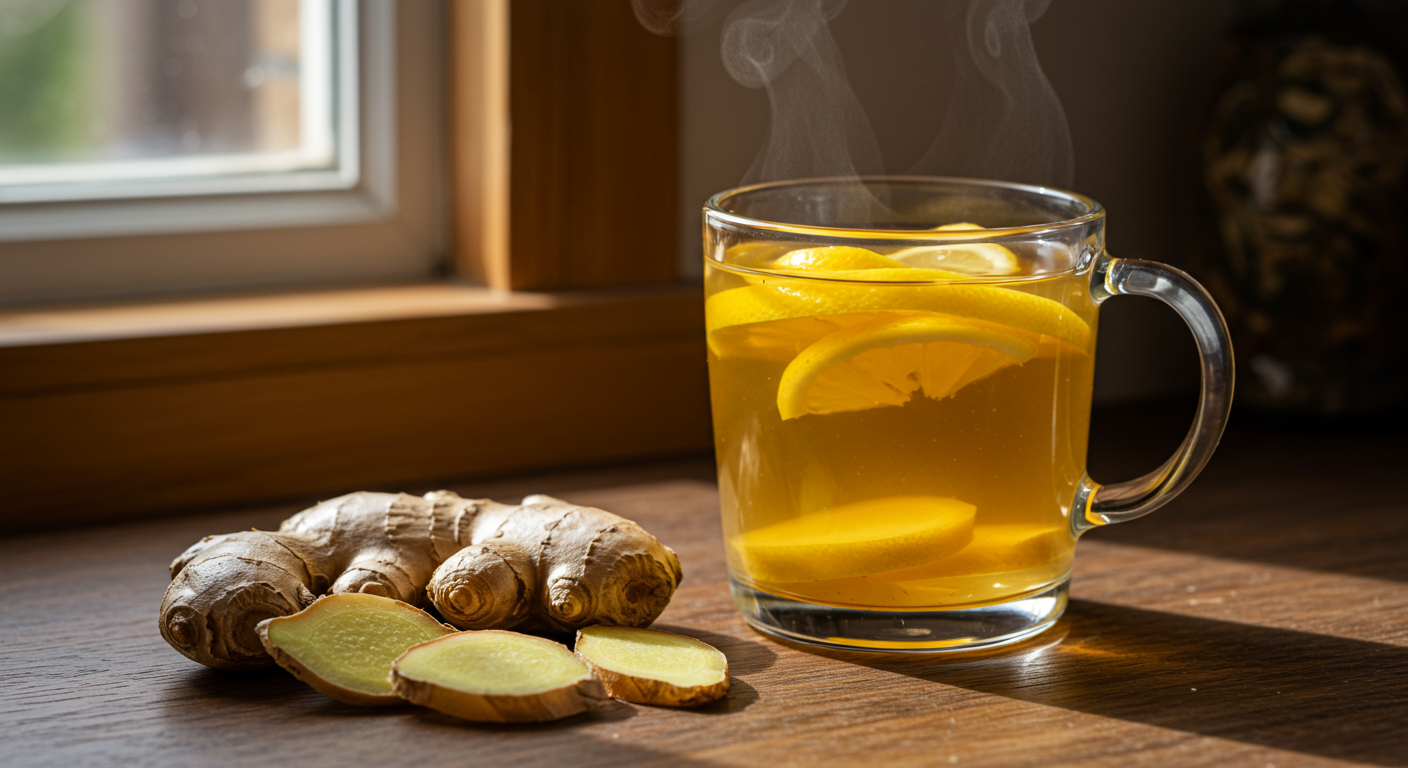
In the kitchens of this country, before the era of convenience foods and energy drinks, people relied on what they grew or could easily buy at the market. Root ginger has been traded in Britain since at least the eleventh century. It arrived via spice routes and quickly became a kitchen staple — tucked into biscuits and cakes, yes, but also simmered quietly in water and lemon to make one of the simplest and most comforting drinks imaginable.
Fresh ginger tea is not complicated. It is not fashionable. It doesn't need a particular brand or a subscription to a wellness app. It requires a piece of fresh ginger root, a lemon, and a kettle — and it has been sustaining British families through grey winters for a very long time indeed.
"A pot of ginger tea on the stove is the smell of being looked after." — A Derbyshire grandmother.
What You'll Need
- A piece of fresh ginger root, about 3–4 cm long
- Half a lemon, freshly squeezed
- 500 ml of water
- 1 teaspoon of honey (optional)
- A pinch of ground cinnamon (optional)
How to Make It
- Peel the ginger and slice it thinly — you want about six to eight slices.
- Place the ginger slices in a small saucepan with the water.
- Bring to a gentle simmer and let it bubble quietly for 10–15 minutes. The longer it simmers, the more robust and warming the flavour.
- Remove from the heat and strain into a mug or teapot.
- Squeeze in the lemon juice and stir in honey if using.
- Add a pinch of cinnamon if you like a slightly spiced quality.
- Drink while warm.
Fresh Versus Dried
This recipe calls for fresh ginger root, which you can find in any supermarket and most corner shops. Fresh ginger has a bright, lively heat that is quite different from the warm, rounded spice of dried ground ginger. For a drink, fresh is preferable — it gives a cleaner, more aromatic result.
That said, if all you have is ground ginger, you can still make a reasonable version: use half a teaspoon of ground ginger stirred directly into hot water with lemon. It won't be quite the same, but it will still be warming and pleasant.
The Lemon Makes a Difference
The addition of lemon to ginger tea is what elevates it from merely warming to genuinely refreshing. The citrus cuts through the heat of the ginger and adds a brightness that lingers pleasantly. Use real, fresh lemon juice — the bottled kind is perfectly functional but lacks the lift of a freshly squeezed fruit.
Some people add a slice of whole lemon to the mug as the tea steeps, which gives a slightly more complex, faintly bitter note. If you enjoy the flavour of lemon marmalade, you'll likely enjoy this version.
Making a Larger Batch
This recipe scales up beautifully. If you're making tea for several people, or want to have some ready in a thermos for the day, simply multiply the quantities and simmer for a little longer. The tea keeps well in a thermos for several hours, and some people find the flavour actually improves as it steeps further.
Stored in the fridge, the strained tea base (before adding lemon) will keep for two to three days. Reheat gently in a saucepan and add fresh lemon juice just before serving.
There is a satisfaction in making something from scratch that no convenience product can quite match.